
What a good payroll check should make visible
A payroll total is the final figure, not the full explanation. A useful check shows the facts, rules, changes and approvals that produced it.
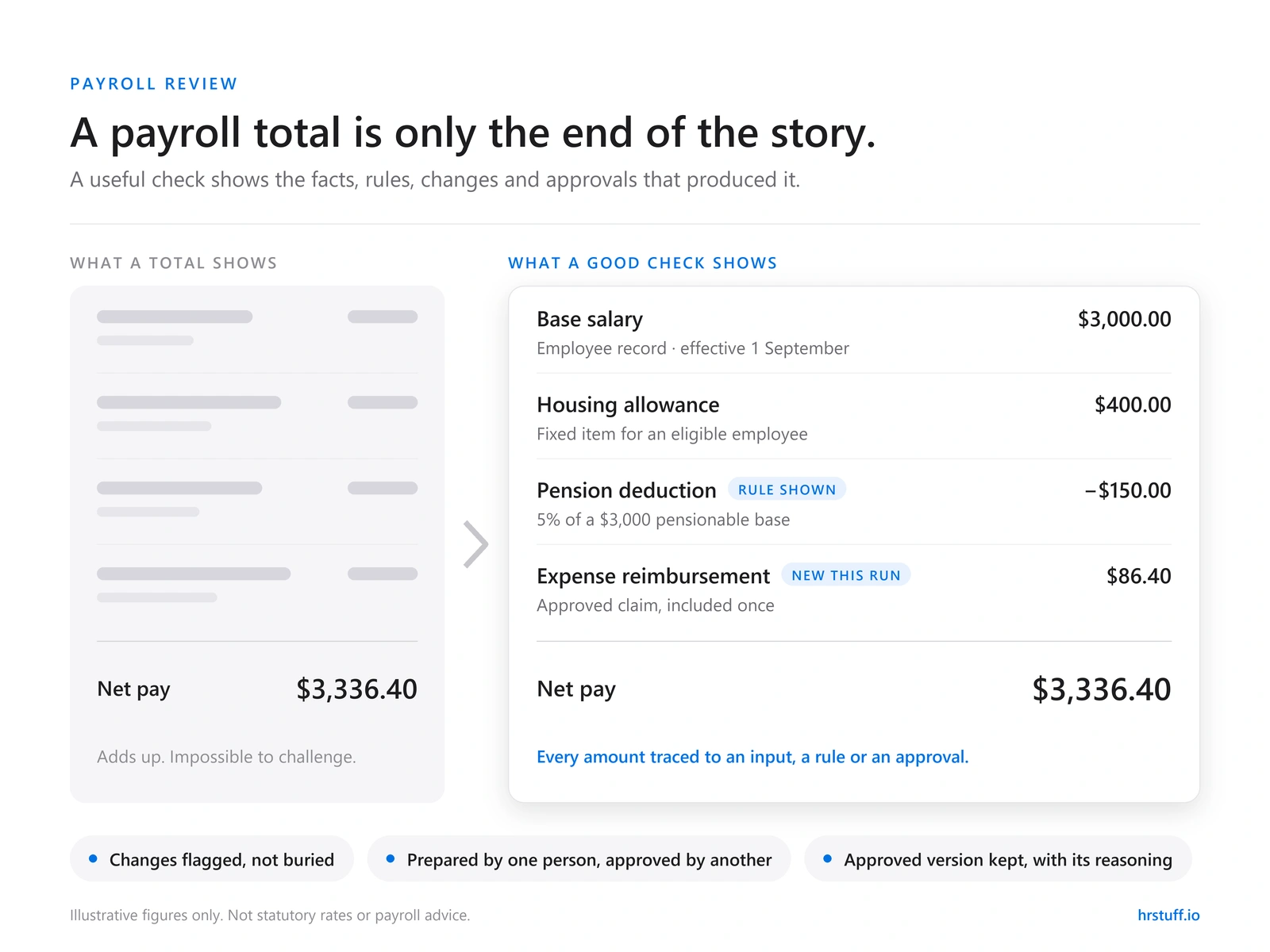
A payroll can add up and still be hard to trust. If a reviewer sees only gross pay, deductions and net pay, they are checking arithmetic, not the decisions behind it.
Most payroll mistakes do not come from a failed calculation. They come from ordinary changes that arrived late, were entered twice, used the wrong effective date or were applied to the wrong person. The final number rarely shows which one happened.
Start with the source facts
Before looking at totals, confirm the facts that define the run. At minimum, the reviewer should be able to see the pay period, currency, the people included, and the date on which each salary or recurring item became effective.
The same view should make exceptional inputs easy to find:
new starters and people leaving during the period;
salary, allowance or eligibility changes;
approved leave or other absence information used by a rule;
one-off claims, reimbursements, bonuses or deductions; and
missing or contradictory information that still needs a decision.
Not every field needs to sit on one enormous screen. It should, however, be one clear step away from the amount it affected. A reviewer should never need to guess which employee record or approval supplied a figure.
Show the rule, not just the result
“Deduction: 150” is a result. “Five per cent of a 3,000 pensionable base” is an explanation. The second version gives the reviewer three useful things to challenge: the rate, the base and whether the rule should apply to this person.
A plain-language calculation trail does not need to expose programming code. It needs to show the order in which items were considered, the values used, and how each step changed the running total.
Illustrative figures only. They are not statutory rates or payroll advice. | ||
Line | What the reviewer can see | Amount |
|---|---|---|
Base salary | Employee record, effective 1 September | $3,000.00 |
Housing allowance | Fixed item for an eligible employee | $400.00 |
Pension deduction | 5% of a $3,000 pensionable base | −$150.00 |
Expense reimbursement | Approved claim, included once | $86.40 |
Net result | Earnings and reimbursement less deduction | $3,336.40 |
Put changes ahead of routine
An ordinary month should be slightly boring. A changed month should not look ordinary.
The review should call attention to differences from the previous run: a new payroll item, a changed salary, a person added or removed, a large swing in net pay, or an amount that appears for the first time. This is more useful than asking someone to scan every unchanged line with equal attention.
Thresholds can help, but they should not pretend to know what is correct. A ten per cent increase may be perfectly reasonable after a promotion. A small duplicate allowance may be wrong. The software can point to the change; a person still needs to understand it.
Separate calculation from approval
The person preparing payroll often knows why an adjustment exists. The approver needs enough context to verify it independently. That is why a useful check records who entered or changed an item, when it changed, and any note or approval attached to it.
This does not require six approval stages. For many small companies, one person can prepare the payroll while another reviews the unusual items and approves the result.
Keep the approved version
Once a payslip or payroll result is published, its explanation should stay with it. A later edit to a salary or calculation rule should not quietly rewrite what the company approved three months ago.
The retained record should connect the result to the inputs and rule versions used at the time, together with the approval. That makes a later question answerable without trying to recreate an old system state from memory.
The final check
Before approval, the reviewer should be able to answer each of these questions without opening a separate spreadsheet:
Does every person expected in this run appear once, and only once?
Do the pay period, currency and effective dates match the intended run?
Are new and changed items clearly identified?
Can every non-obvious amount be traced to an input, rule or approval?
Are warnings and missing information resolved or deliberately accepted?
Does each final amount match what the company actually intends to pay?
Visibility is not the same as correctness. A beautifully explained calculation can still use the wrong local rule. The point is to make mistakes easier to spot and decisions easier to defend, not to replace the people responsible for payroll.
That is the standard we think payroll software should meet: show the result, show the reasoning, and preserve both after approval.